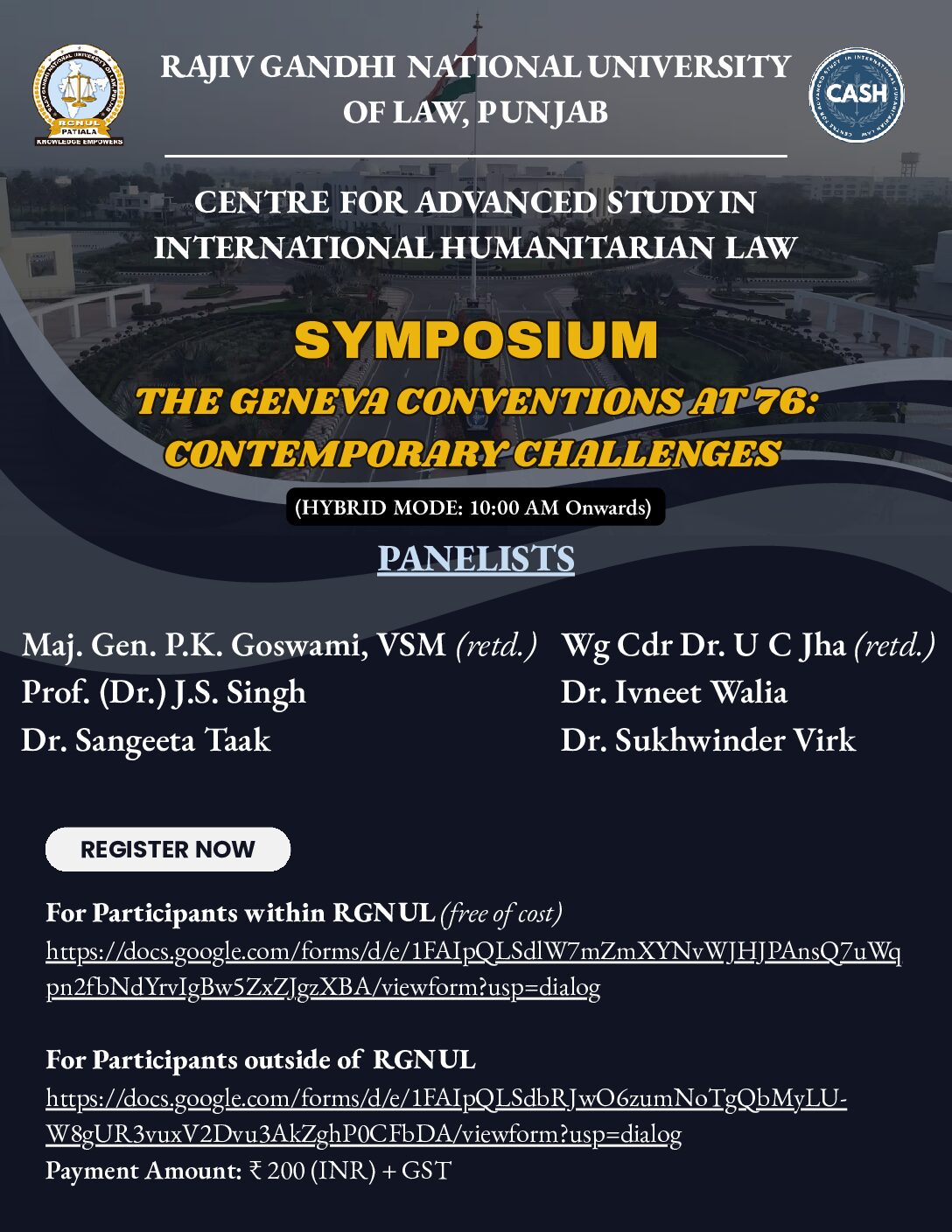
CALL FOR REGISTRATIONS: FOR SYMPOSIUM ON THE GENEVA CONVENTIONS AT 76: CONTEMPORARY CHALLENGES, RGNUL
HYBRID MODE
PANELISTS
- Maj. Gen. P.K. Goswami, VSM (retd.)
- Prof. (Dr.) J.S. Singh
- Dr. Sangeeta Taak
- Wg Cdr Dr. U C Jha (retd.)
- Dr. Ivneet Walia
- Dr. Sukhwinder Virk
About RGNUL
The Rajiv Gandhi National University of Law (RGNUL), Punjab, was established by the State Legislature of Punjab by passing the Rajiv Gandhi National University of Law, Punjab Act, 2006 (Punjab Act No. 12 of 2006). The Act incorporated a University of Law of national stature in Punjab, to fulfill the need for a Centre of Excellence in legal education in the modern era of globalization and liberalization. RGNUL started functioning from its Headquarters-Mohindra Kothi, The Mall, Patiala w.e.f. 26 May 2006. The University acquired approval of the Bar Council of India (BCI) in July 2006. The University also got registered with the University Grants Commission (UGC), New Delhi under Section 2(f) of the University Grants Commission Act, 1956 and has been declared fit to obtain grant from the (UGC) under Section 12-B of the UGC Act, 1956. RGNUL operated from heritage building of the erstwhile Patiala State, Mohindra Kothi, The Mall, Patiala (from 2006 to 2013) located in the heart of Patiala city in a pollution free environment. The University was accredited with ‘A’ Grade by National Assessment and Accreditation Council (NAAC) in 2015. RGNUL, Punjab was granted autonomy under UGC Regulations, Clause 5 Dimensions of Autonomy for Category-II Universities in April 2018.The Ministry of Human Resource Development, Government of India, ranked RGNUL the first amongst the cleanest Higher Educational Institutions, Swachh Campus (2019) in the category of Government Residential Universities.
About CASH, RGNUL
CENTER FOR ADVANCED STUDY IN INTERNATIONAL HUMANITARIAN LAW (CASH)
ABOUT THE INTERNATIONAL HUMANITARIAN LAW
International Humanitarian Law (IHL) is a set of rules which seeks, for humanitarian reasons, to limit the effects of armed conflict. It protects the persons who are not, or are no longer, participating in the hostilities and restricts the means and methods of warfare. International Humanitarian Law is also known as the ‘Law of War’ or the ‘Law of Armed Conflict’.
The Geneva Conventions of 1949 and their Additional Protocols of 1977 require the State Parties to disseminate the content of these humanitarian treaties as widely as possible in their respective countries. Of course, their inclusion in the military instructions is indispensable to ensure their implementation in the times of armed conflict. However, it is equally important to promote the knowledge of Humanitarian Law among those whom it is intended to protect – the civilian population as well as among those who have to apply it. At the same time, political leaders policy planners and the decision-makers must also be familiar with the law so that they are aware of its relevance, realism and mode of operation, if and when a conflict breaks out.
REGISTRATION
- For Participants within RGNUL (free of cost)- HERE
- For Participants outside of RGNUL-
- Payment Amount: ₹ 200 (INR) + GST
For more details, refer here