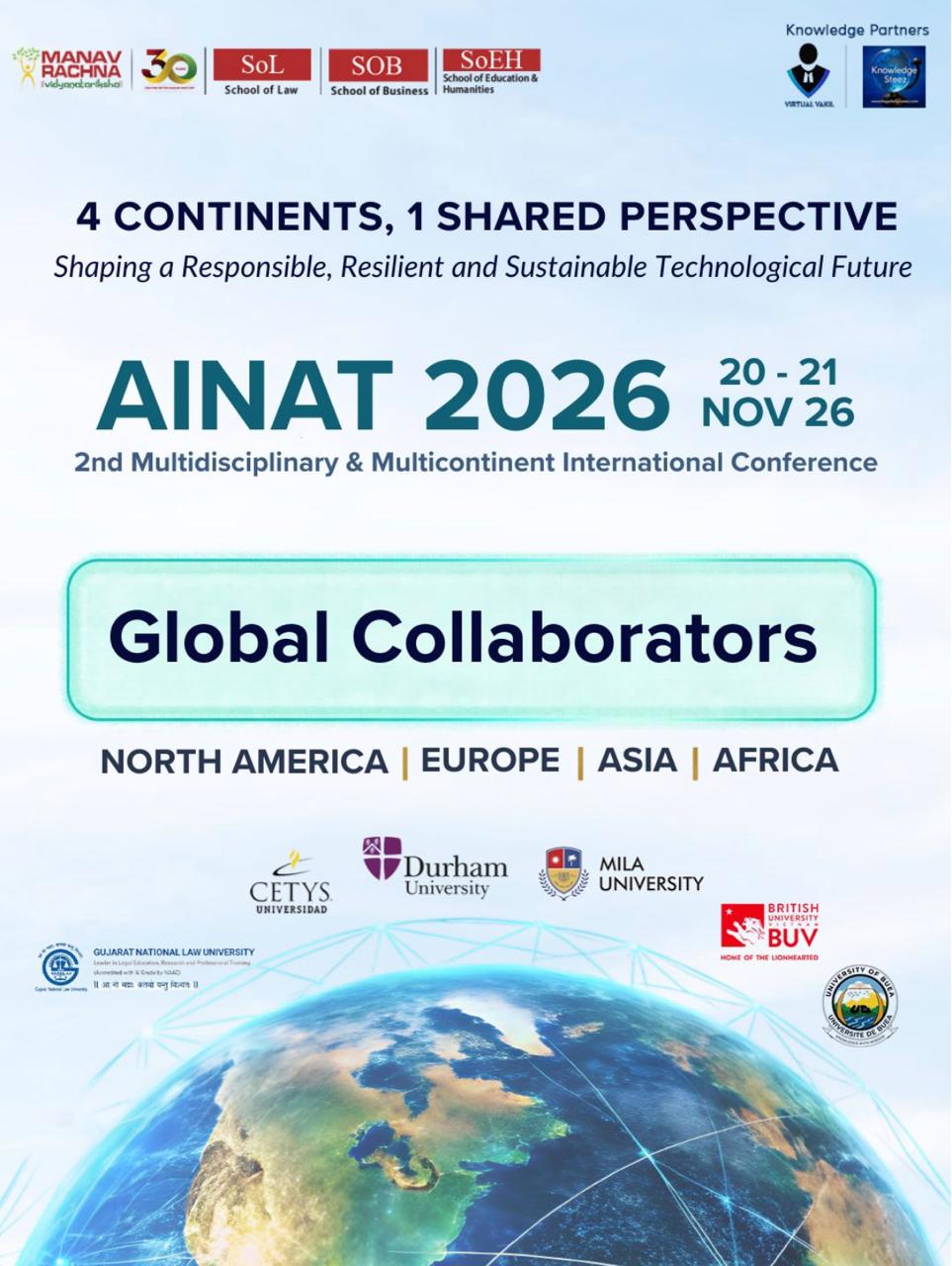
2nd Multidisciplinary & Multicontinent International Conference
AI & NEW AGE TECHNOLOGY AINAT 2026
Responsible Technology for a Resilient Sustainable Future 20TH-21ST NOV, 2026
ABOUT THE INTERNATIONAL CONFERENCE:
In an era shaped by rapid technological advancement, Artificial Intelligence (AI) and emerging digital technologies are redefining the foundations of human interaction, governance, industry, and education. As societies navigate the complexities of digital transformation, the growing influence of AI demands critical reflection to ensure that innovation aligns with ethical, inclusive, and sustainable development. Although technology offers transformative potential to advance human development and support the United Nations Sustainable Development Goals (SDGs), it also poses complex challenges related to ethics, equity, accountability, data privacy, environmental degradation, labour displacement, and social vulnerability. As the world confronts climate instability, economic uncertainty, public health risks, and widening digital divides, the need for responsible, inclusive, and sustainable technology governance becomes more critical than ever. To advance this dialogue, Manav Rachna University is pleased to host the 2nd International Multidisciplinary Conference on Artificial Intelligence and New Age Technology (AINAT 2026) on the theme “Responsible Technology for a Resilient Sustainable Future.”
AINAT 2026 seeks to bring together global scholars, researchers, educators, policymakers, technologists, legal experts, entrepreneurs, and industry leaders to engage in cross-disciplinary knowledge exchange. The conference aims to explore how responsible and human-centered AI can support social equity, environmental stewardship, economic resilience, and educational transformation ensuring that technology remains a catalyst for collective progress rather than disparity. AINAT 2026 emphasizes the urgent need to embed ethics, accountability, and sustainability into the technological ecosystem, ensuring that innovation uplifts, empowers, and protects.
The conference will be organized across interdisciplinary tracks aligned to the core strengths of the University’s academic schools. It will feature expert keynote lectures, policy dialogues, thematic paper presentations, workshops, and industry-academia networking sessions. The conference aims to foster research collaborations, publication opportunities, and actionable strategies that support sustainable and ethical technological ecosystems.
CALL FOR PAPERS:
The 2nd Multidisciplinary International Conference on “Responsible Technology for a Resilient Sustainable Future”, organised by the Manav Rachna University, will be held from 20-21 November 2026. The Conference invites contributions in the form of full-length scholarly papers documenting original and substantial research work.
Here are the themes and sub-themes:
Theme 1: Law, Governance & Global Sustainability (Mapped with SDG 13, 16, 17):
- International & comparative environmental law: treaties, compliance, enforcement challenges.
- Cross-border environmental issues & transnational governance.
- Climate litigation, accountability & judicial activism.
- Rights of indigenous & vulnerable communities in environmental law.
- Transparency, disclosure & green justice mechanisms.
Theme 2: Sustainability, Equity and Human Rights (Mapped with SDG 5, 10, 13, 16):
- Gender dimensions in climate governance.
Equitable access to natural resources. - Youth leadership for sustainable and Equitable Future.
- Civic participation, grassroots movements & sustainable justice/ Just sustainability.
- Social innovation & community empowerment for sustainability.
Theme 3: Business, Management & Corporate Sustainability (Mapped with SDG 8, 9, 12, 13):
- ESG (Environmental, Social & Governance) frameworks in practice.
- Corporate accountability for carbon footprints.
- Circular economy & regenerative business models.
- Green finance, impact investing & sustainable business strategies.
- CSR 2.0 & stakeholder-driven governance models.
- Responsible supply chains & sustainable HR practices.
Theme 4: Science, Technology & Digital Futures for Sustainability (Mapped with SDG 7, 9, 11, 12, 13):
- Renewable energy, clean tech & sustainable agriculture.
- AI, big data & digital tools for equitable climate action.
- Green mobility, smart cities & digital governance frameworks.
- Materials science & responsible innovation.
- Tech-enabled monitoring & policy integration for sustainability.
- Balancing digital transformation with ethical governance.
Theme 5: Education, Research & Innovation for Sustainable future (Mapped with SDG 4, 9, 13, 17):
- Reimagining curricula and pedagogies for AI literacy, ethics, and responsible innovation.
- Higher education institutions as living labs for sustainable and inclusive AI practices.
- Harnessing technology and AI for equitable, transparent, and sustainable governance.
- Community-based digital education fostering global citizenship in the AI era.
- Lifelong learning pathways for adaptive and ethical AI leadership.
- Youth empowerment and entrepreneurial innovation for AI-enabled sustainable transitions.
Theme 6: Culture, Arts & Social Narratives of Sustainability (Mapped with SDG 11, 12, 13, 16):
- Literature, storytelling & digital narratives shaping public understanding of AI.
- Arts, media & popular culture interpreting ethical dimensions of AI.
- Community voices & regional perspectives in inclusive AI governance.
- Cultural expressions of belonging, identity & creativity in the age of AI.
- Behavioral and societal change through AI-driven cultural transformation.
- Interdisciplinary dialogues between culture, law, ethics & emerging technologies.
[Note: Above themes are illustrative, researchers can submit their papers relevant to above themes and other relevant themes.]
SUBMISSION GUIDELINES:
Abstract Submission
The abstract must be developed & submitted in Word Document Format typed in Times New Roman in 12 font size with [line spacing] in not more than 300 words. It should not contain more than eight keywords.
The abstract should contain personal details of the author(s) in the order: Title of the Paper, Name, Designation, Institute/University/College/Organization, Contact Number, E-mail, and Address of Correspondence of the Author(s).
Kindly indicate the name of the main author for correspondence cases of more than one author(s).
Acceptance of the Abstract will be communicated via E-mail by 27th October 2026.
Full Paper Submission:
The word limit of the paper shall be 5000-6000 words.
The main text of the full paper should be in Times New Roman with a font size of 12 and a line spacing of 1.5.
Click here to access the complete guidelines for submission.
Full papers have to be submitted in (Word) .docx format.
Registration is mandatory upon acceptance of the abstract. The link to the registration form will be shared via email with selected participants.
No abstract or full paper shall be accepted after the last date of submission.Only the selected abstracts will be permitted for presentation.Co-authorship is permitted to a maximum of two authors and at least one author must attend the Conference to present paper.
All submissions must be the author’s original and unpublished work.More than 10% similarity & more than 5% AI will attract immediate disqualification.
SUBMISSION PROCESS:
The submission link for the full paper and payment will be shared through E-mail only to the participants whose abstract is selected. Submit Abstract Here: https://forms.gle/yj3DJwKgVhz7KcDy7
PRE-CONFERENCE WORKSHOP:
Date: 19th November 2026
Mode: Hybrid
Registration Fee:
Indian Participants: ₹1,000 + GST per session
International Participants: 50 USD + GST
THEMES:
Law: Use of AI Technology Tools in Legal Education and Research
Management: Prompt to Publication: AI Tools for Modern Management Researchers
Education: AI-driven Assessment Policy and Guidelines for Higher Education Institutions
MODE OF CONFERENCE: HYBRID
IMPORTANT DATES:
Conference Dates: 20th & 21st November 2026
Pre-Conference Workshop: 19th November 2026
Abstract Submission Deadline: 22nd October 2026
Abstract Acceptance Notification: 27th October 2026
Full Paper Submission Deadline: 6th November 2026
Full Paper Acceptance Notification: 12th November 2026
FEE PAYMENT
Step 1: Participants will have to make payment on the given bank details:
Bank Name: HDFC Bank Limited
Account Name: Manav Rachna University Operations
Account No: 50200050331373
IFSC Code: HDFC0002549
Step 2: Fill out the registration form with all of the necessary information and add the screenshot of the payment details.
Note – Authors who are ready with the final papers before the submission deadline can directly send them via email to: ainat2026@gmail.com
REGISTRATION FEE:
UG/PG Students/Research Scholars: Amount (INR): 1000 | Total Fees after Tax: 1180
Academicians: Amount (INR): 1500 | Total Fees after Tax: 1770
Industry Participants: Amount (INR): 2500 | Total Fees after Tax: 2950
International Participants: Amount: 35 USD | Total Fees after Tax: 42 USD
Pre Conference – Indian: Amount (INR): 1000 | Total Fees after Tax: 1180
Pre Conference – International Participants: Amount: 50 USD | Total Fees after Tax: 59 USD
*The Registration amount is per Author
For more details refer here