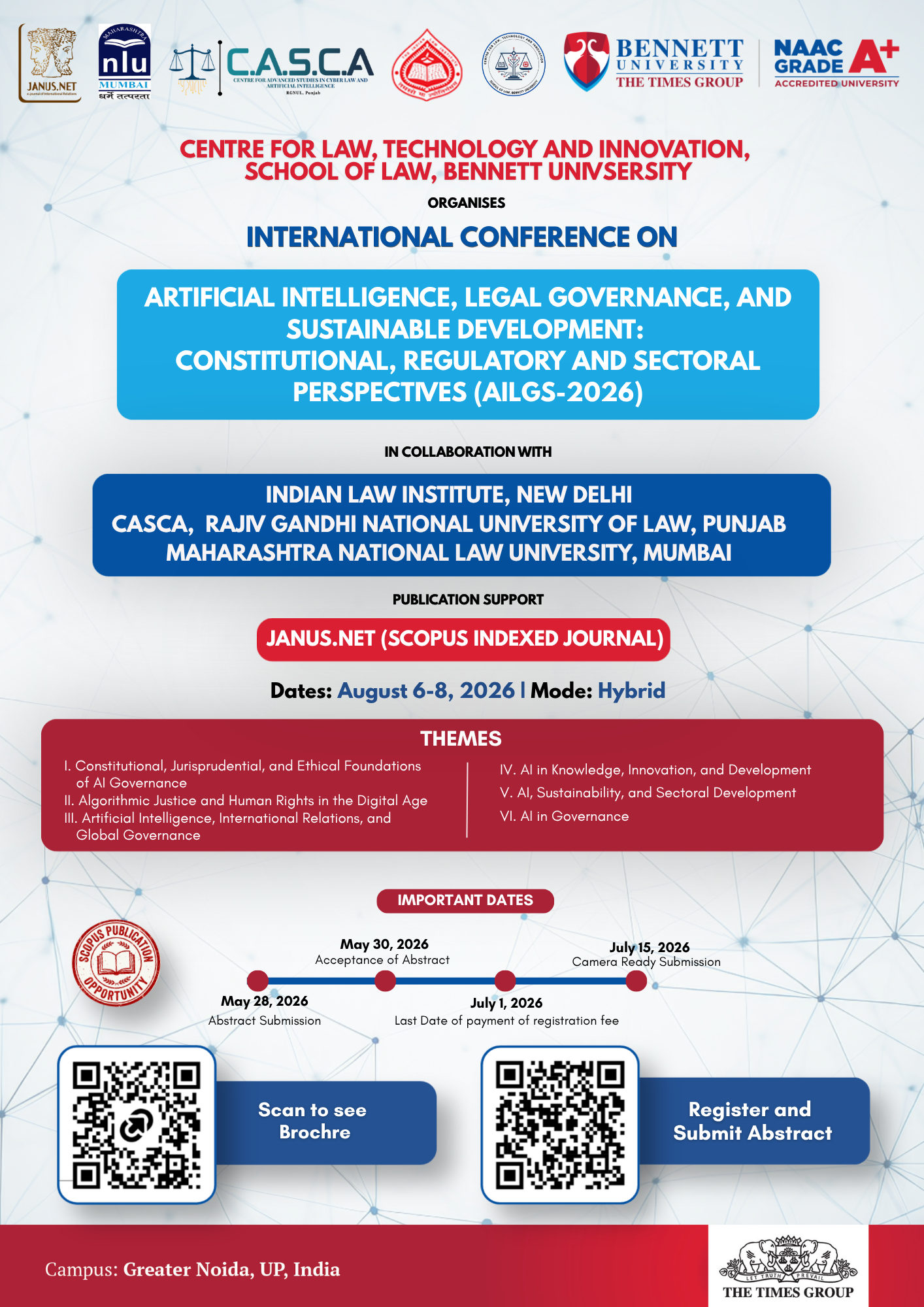
Call for Papers: INTERNATIONAL CONFERENCE on Artificial Intelligence, Legal Governance, and Sustainable Development: Constitutional, Regulatory, and Sectoral Perspectives (AILGS-2026), 6-8 August 2026
Organised by
Centre for Law, Technology and Innovation,
School of Law, Bennett University
in Collaboration with
Indian Law Institute, New Delhi
Centre for Advanced Studies in Cyber Law and Artificial Intelligence
(CASCA), Rajiv Gandhi National University of Law, Punjab
Maharashtra National Law University, Mumbai
Publication Support
JANUS.NET e-Journal of International Relations (Scopus Indexed)
6th , 7th and 8th August 2026
Mode: Hybrid
The School of Law, Bennett University, through its Centre for Law, Technology and
Innovation (CLTI), in collaboration with the Indian Law Institute, the Centre for
Advanced Studies in Cyber Law and Artificial Intelligence (CASCA), Rajiv Gandhi
National University of Law, Punjab and Maharashtra National Law University
Mumbai, and publication collaboration with the JANUS.NET e-Journal of International
Relations (Scopus Indexed), is pleased to announce the International Conference on
“Artificial Intelligence, Legal Governance, and Sustainable Development: Constitutional,
Regulatory and Sectoral Perspectives”, scheduled to be held from August 6-8, 2026 in Hybrid
mode.
The conference invites original and unpublished submissions on the following themes and
sub-themes:
1. Constitutional, Jurisprudential, and Ethical Foundations of AI Governance
Conceptualising AI as a regulatory object
Rule of law, proportionality, and due process in algorithmic decision-making
Constitutional limits on automated governance and public power discretion
Human dignity, autonomy, and technological mediation
Ethical principles in AI deployment and accountability frameworks
2. Algorithmic Justice and Human Rights in the Digital Age
Privacy, data protection, and informational self-determination
Bias, discrimination, and algorithmic fairness
Freedom of expression, association, and assembly in AI-mediated contexts
Access to justice, AI-enabled adjudication, and rights-based remedies
Equity, social inclusion, and non-discrimination in AI systems
3. Artificial Intelligence, International Relations, and Global Governance
Global and multilateral AI governance and the role of international organisations
Geopolitics of AI, regulatory competition, and strategic autonomy
International human rights, digital sovereignty, and cross-border data governance
AI, sustainable development, and international cooperation
Sovereignty and digital jurisdiction
4. AI in Knowledge, Innovation, and Development
Algorithmic decision-making in education, research, and evaluation
Academic integrity, surveillance, and student privacy
Intellectual property, AI-generated works, and innovation policy
Knowledge commons, trade secrets, and open innovation
AI as a driver of economic development, labour governance, and inclusive growth
5. AI, Sustainability, and Sectoral Development
AI in energy, environment, and climate governance
Algorithmic support for sustainability, resource allocation, and green AI
AI for achieving Sustainable Development Goals (SDGs)
Addressing global inequalities, digital colonialism, and development justice
International cooperation, accountability, and capacity-building in AI deployment
6. AI in Governance
AI in public administration and governance
Smart cities and urban governance
Policy design and welfare delivery
Policing, surveillance, and law enforcement
PUBLICATION OPPORTUNITY
A limited number of high-quality papers presented at the conference will be selectively
considered for publication in the JANUS.NET e-Journal of International Relations (Scopus
Indexed), subject to a rigorous double-blind peer-review process. No publication fee shall be
charged.
About the Journal:
The JANUS.NET e-Journal of International Relations is a peer-reviewed, open-access
academic journal published by OBSERVARE–Observatory of Foreign Relations,
Universidade Autónoma de Lisboa, Portugal. It follows internationally recognised standards
of scholarly publishing, including a double-blind peer-review process, and is indexed in
leading databases such as Scopus, SCImago, DOAJ, and EBSCO. The journal adopts an
interdisciplinary approach, welcoming contributions across law, political science,
international relations, and allied fields, and provides a global platform for high-quality
research on contemporary international and governance issues.
IMPORTANT DATES
Abstract Submission Deadline: 28 May 2026
Acceptance Notification: 30 May 2026
Full Paper Submission: 15 July 2026
Registration Fee Payment: 1 July 2026 (or as notified)
Dates of Conference: August 6-8, 2026 (Hybrid)
Submission Link
WHO SHOULD PARTICIPATE
Faculty members, researchers, doctoral scholars, students, legal practitioners, policymakers,
and industry stakeholders engaged in law, technology, governance, and allied disciplines.
For more details, refer here