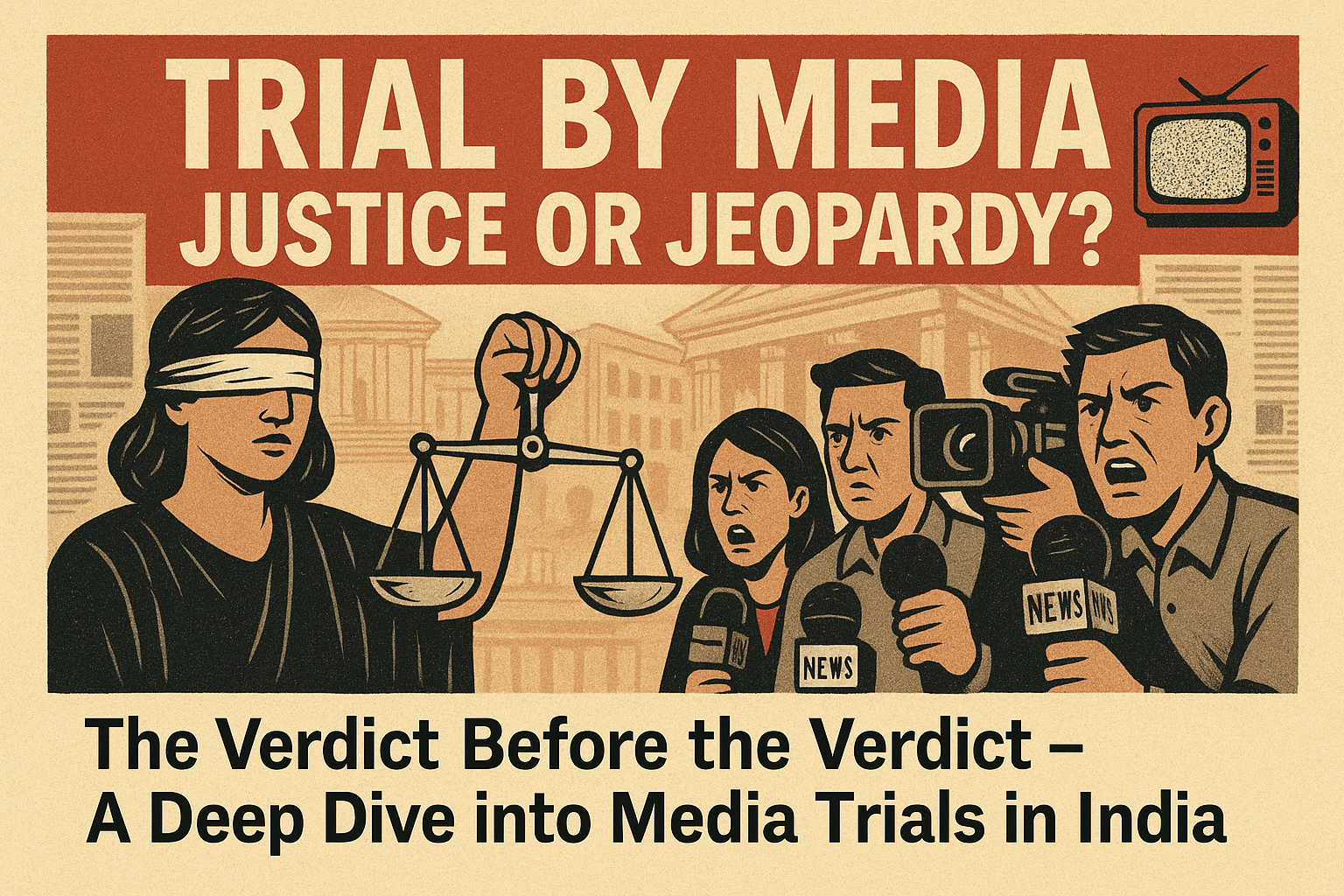
The Verdict Before the Verdict – A Deep Dive into Media Trials in India ” Trial by Media: Justice or Jeopardy?”
1. Introduction:
The Rise of the Digital Courtroom “The pen is mightier than the sword”, they say. But in modern India, it seems the mic is mightier than the gavel. The rapid evolution of the news industry and the advent of social media have changed the landscape of justice. Media trials the phenomenon where media outlets conduct a parallel investigation and verdict delivery, often ahead of the courts have become rampant. Though the media plays a vital role in bringing attention to societal issues, its interference with the judicial process raises serious concerns.
From “Breaking News” banners to hashtag activism, the thin line between public interest and public prejudice is being blurred. The question is no longer about whether the media should inform the public, but whether it is now deciding guilt before the courts do.
2. Legal Framework: Balancing Freedom and Fairness
The Indian Constitution upholds the freedom of speech and expression under Article 19(1)(a). However, this freedom is not absolute. Article 19(2) places reasonable restrictions, especially concerning contempt of court, defamation, and maintaining the sovereignty and integrity of India. Simultaneously, Article 21 guarantees the right to life and personal liberty, which includes the right to a fair trial. When media coverage influences public opinion to the extent that it jeopardizes the fairness of a trial, it poses a constitutional conflict.
Under the Contempt of Courts Act, 1971, any publication that tends to interfere with or prejudice judicial proceedings constitutes contempt. Prejudicial reporting can derail justice, especially during sub judice matters (cases still under trial).
“Justice should not be for sale to the highest TRP bidder.”
3. Media trial and freedom from media
A “trial by media” refers to the impact of television, newspapers, and social media on a person’s reputation by creating a widespread perception of guilt or innocence before, or after, a verdict in a Court of law. This phenomenon can influence public opinion and potentially affect the fairness of judicial proceedings. Media trials involve the media conducting its own investigation and forming public opinion about a suspect or accused person even before the Court has reached a verdict. Media trials can prejudice the public, affect judicial functioning, and lead to wrongful portrayals of individuals, instigating hatred and violence against them.
In Nilesh Navlakha v. Union of India,(2020), it was held that the freedom of the media, especially of the TV channels, cannot be allowed to super stretch to a point where, by outpouring reprobate information, begins to clog and cloud the pellucid comprehension of ‘facts/news’ in the people’s minds and impinges upon free and fair investigation. ‘Freedom of speech and expression’ guaranteed by Article 19(1)(a) of the Constitution is said to be the life blood of our democracy, subject to reasonable restrictions under Article 19(2).
There is danger of serious risk of prejudice if the media exercises an unrestricted and unregulated freedom such that it publishes photographs of the suspects or the accused before the identification parades are constituted or if the media publishes statements which outrightly hold the suspect or the accused guilty even before such an order has been passed by the Court. It is to be ensured that trial by media does not hamper fair investigation by the investigating agency and more importantly does not prejudice the right of defense of the accused in any manner whatsoever.
5.Iconic Examples of Media Trials
5.1 Apoorva Arora & Anr. v. State (Govt. of NCT of Delhi), 2024 SCC OnLine SC 3252: The Supreme Court quashed the criminal cases under Sections 67 and 67A of the Information Technology Act, 2000 (IT Act) against the artists of the web-series and held that the availability of content that contains profanities and swear words cannot be regulated by criminalizing it as obscene. The metric to assess obscenity and legality of any content cannot be that it must be appropriate to play in the courtroom while maintaining the Court’s decorum and integrity. The Hon’ble Supreme Court emphasized the importance of the right to freedom of expression under Article 19(1)(a) through the media and opined that it is a disproportionate and excessive measure that violates freedom of speech, expression, and artistic creativity to criminalize the publication of the impugned series, labelling it as obscene.
5.2 Sushant Singh Rajput Case (2020): The actor’s tragic death became a media circus. News channels ran speculative stories, paraded private chats, and named individuals without evidence. The Bombay High Court later stated that such reporting was contemptuous and harmed ongoing investigations.
5.3 Aryan Khan Drug Case (2021): Even before charges were confirmed, media trials painted the young man guilty. Sensationalized coverage swayed public sentiment, yet the investigation eventually found no drugs on Aryan and no evidence of a larger conspiracy.
5.4 Jessica Lal Case (1999): In contrast, media pressure revived a case that had gone cold. When Manu Sharma was acquitted, public outrage spurred by the media led to a retrial, which ultimately resulted in conviction.
“The media can be the voice of the voiceless or the judge of the innocent.”
6. Impact on the Judicial System
The relationship between the judiciary and the media is an interplay of transparency, accountability, and the integrity of the judicial process. The media (press), referred to as the “fourth estate,” plays a very crucial role in informing the public, shaping opinions, and holding the Government machinery, leaders and institutions accountable. However, this relationship can sometimes lead to conflicts, particularly when media coverage influences public perception and judicial proceedings.
The media helps in forging public trust in the judicial system. It can increase pressure on the accountability of judges and thus further enhance the legitimacy of Courts, by which the Judiciary in turn shape’s public opinion. When the public sees judges as independent, impartial, and objective, it will respect the judgments, even though it may disagree with them. However, social media is indiscriminately misused by some members of the general public to defame and harass judges, for their fair, independent impartial decisions on matters before them.
7. Critical Analysis:
The Double-Edged Sword Media trials are not inherently evil. In several cases such as Nirbhaya (2012), Priyadarshini Mattoo (1996), and Jessica Lal (1999) media attention has played a role in bringing justice. However, when media shifts from being a mirror to a magnifier, distorting facts for sensationalism, it compromises democratic values.
Key Problems:
Lack of legal literacy among journalists
TRP driven sensationalism
Absence of strict media ethics enforcement
No real-time accountability
“A camera lens should capture truth, not manufacture guilt.”
8. Need for Reform: Drawing the Line
8.1 Press Council of India Guidelines: Strengthen and make these guidelines enforceable with real consequences.
8.2 Judicial Oversight: Empower courts to pass postponement orders swiftly.
8.3 Media Ethics Curriculum: Journalism schools must include legal and ethical training.
8.4 Contempt Action: Increase use of contempt proceedings for prejudicial reporting.
8.5 Legislative Framework: Consider a Media Regulation Act to oversee coverage of sub judice matters.
9. Conclusion: Let the Gavel Speak First
Today the media plays a significant role in influencing trails of high-profile cases which includes gauging and commenting on the efficacy of the court in which the trial is going on. Various studies have successfully shown the influence and effect of media trials on the justice system either directly or indirectly.
Media trials have emerged as a major issue in India which needs to be addressed as soon as possible because of its harmful effect on society at large. Media has risen as a superpower overnight and is now challenging the authority of the judiciary or court of law. It has reduced the judiciary to a mere silent bystander being scapegoated by the unchecked and uninhibited power of freedom of press. Media has come to a position where it‘s now controlling the minds of the citizens through rule of law with the support of the Constitution and technological advancements. As India continues to evolve as a democracy, the media’s role remains pivotal. However, with great power comes great responsibility. It’s time to reflect: Shouldn’t justice be decided in a courtroom, not a newsroom?
“Innocent until proven guilty, not trending until proven guilty.”
10. Bibliography
1. The Constitution of India – https://legislative.gov.in/constitution-of-india
2. The Contempt of Courts Act, enacted in 1971 – https://indiankanoon.org/doc/1737746/
3. Press Council of India – http://presscouncil.nic.in/
4. Coverage of the Aryan Khan case – https://www.thehindu.com/news/cities/mumbai/ncb-doesnot-name-aryan-khan-in-charge-sheet-in-drug-racket-case/article65466333.ece
5. Details on the Jessica Lal retrial – https://timesofindia.indiatimes.com/india/jessica-lal-murdercase-all-9-accused-acquitted/articleshow/1423413.cms
6. Judiciary and Media – https://aphc.gov.in/docs/judiciary_media.pdf
7. https://articles.manupatra.com/article-details/Media-Trials-Misuse-of-Freedom-of-Speechand-Deterrent-in-the-path-of-Justice
8. Landmark Judgements – https://indiankanoon.org/search/?formInput=media%20trial
Written By
Aanya Mitra
Student of BBLLB from USLLS, GGSIPU