ABOUT DHARMASHASTRA NATIONAL LAW UNIVERSITY (DNLU) JABALPUR
Dharmashastra National Law University, Jabalpur (M.P.) ‘DNLU’ India is one of the leading and premier law institutes imparting legal education and research. The University was established in the year 2018 by Madhya Pradesh Dharmashastra National Law University Act 24 of 2018, with the object of advancing the cause of legal education and achieving excellence as a university for imparting value-based legal education.
ABOUT THE CENTRE FOR LAW & ECONOMICS (CLE), DNLU JABALPUR
The Centre for Law and Economics (CLE), established under the aegis of Dharmashastra National Law University, Jabalpur (M.P), aims to promote research in the intertwined fields of Law and Economics, understanding the critical interdependence between the state of the economy and economic laws.
AIM & OBJECTIVES OF THE CENTRE (CLE)
The Centre is dedicated to empowering stakeholders, from students and scholars to policymakers and businesses, with the knowledge, tools, and insights necessary to navigate the evolving legal and economic landscape, ensuring the nation’s aspirations for growth and development are met with a sound, adaptable, and forward-thinking legal framework.
ABOUT THE CENTRE FOR RESEARCH IN ENVIRONMENTAL LAW (CREL), DNLU JABALPUR
The Centre for Research in Environmental Law (CREL) under the Dharmashastra National Law University (DNLU), Jabalpur, is an endeavour of the University to respond to the need for legal scholarship in the areas of conservation of environment and forest, abatement of pollution, preserving biodiversity, maintaining ecological balance, improving environmental awareness and education, etc.
ABOUT THE CONFERENCE
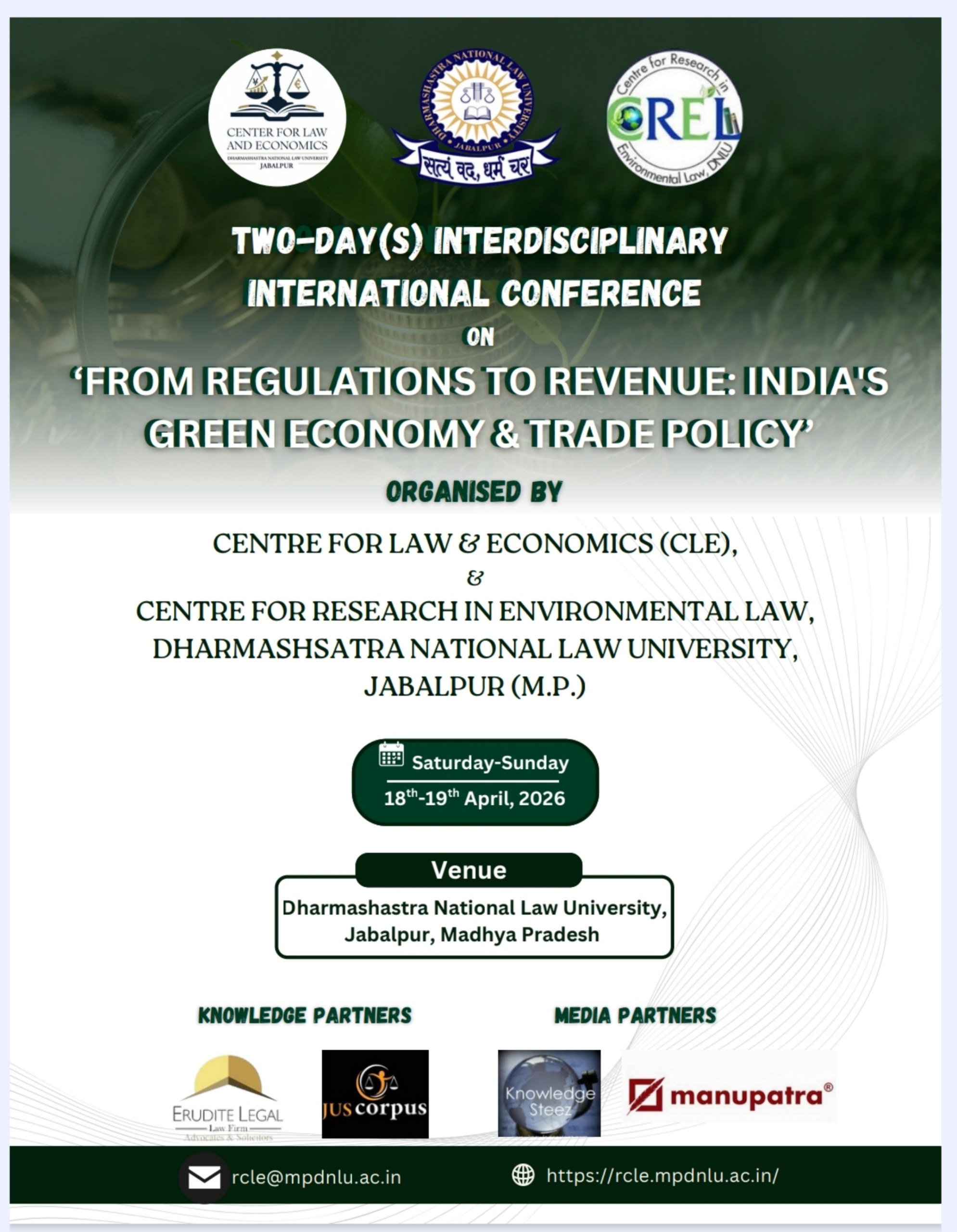
The global imperative for sustainable development has positioned the green economy at the forefront of economic transformation. In the context of India, a nation characterized by its burgeoning economy and pressing environmental challenges, the transition from regulation-driven environmental policies to a revenue-generating green economy has emerged as a pivotal theme.
MEDIA PARTNER – Knowledgesteez
AIM & OBJECTIVE
This interdisciplinary conference aims to dissect India’s journey, challenges, and opportunities in achieving this transformation, shedding light on law and policy frameworks, economic incentives, technological advancements, and private-sector participation. The primary objective is to explore and analyze the paradigm shift in India’s green economy—moving from regulatory mechanisms to revenue-generating sustainable practices, with a particular emphasis on the role of international trade law and economic policy in shaping India’s green economy transition.
THEME
FROM REGULATIONS TO REVENUE: INDIA’S GREEN ECONOMY & TRADE POLICY
SUB-THEMES
- Regulatory Foundations and Trade Policies
- Economic Potential of the Green Economy
- Technology, Innovation, Green Trade, Decarbonization, Renewable Energy & Energy Efficiency
- Private Sector, Trade, and Revenue Generation
- Socioeconomic Benefits of Green Trade
- Global Context, Collaboration, and Trade Partnerships
- Circular Economy, Waste-to-Energy and Waste Management
- Carbon Markets and Emission Trading Systems
- Technological Innovations and Sustainable Trade Systems
WHO CAN ATTEND?
This conference will bring together policymakers, researchers, students, academics, and industry leaders to engage in dialogue and share insights into India’s green growth trajectory, drawing on interdisciplinary perspectives from law, economics, and public policy.
DATES
18 -19 April, 2026
VENUE
Dharmashastra National Law University, Jabalpur, Madhya Pradesh
AWARDS & BENEFITS
- Selected papers will be published in an Edited Book with an ISBN.
- Top 5 Papers will be awarded with certificate of merit.
- All the presenters & attendees will be awarded the Certificate of Paper Presentation & Certificate of Participation respectively.
IMPORTANT DATES
- Last Date for Submission of Abstract: 20th February, 2026
- Intimation of Selection of Abstract: 22nd February, 2026
- Last Date of Registration: 25th February, 2026
- Submission for Full Papers: 28th February, 2026
- Date of Conference: 18 – 19 April 2026
How to submit Abstract?
https://forms.gle/6ztm9YRwovabCzYY6
SUBMISSION GUIDELINES
- All submissions shall be subjected to a double-blind peer review process, focusing on originality, quality of research, methodological rigor, and soundness of conclusions.
- Manuscripts must be original, unpublished, and not under consideration elsewhere. Simultaneous submissions are strictly prohibited.
- Any form of plagiarism and use of AI will result in immediate rejection without an opportunity for resubmission.
- The title of the manuscript must be in 16-point Times New Roman.
- The main text must be in 12-point Times New Roman, single-spaced, with 2.54 cm margins on all sides.
- Citations and footnotes must be in 10-point Times New Roman, single-spaced, and must strictly follow the 20th edition of the Bluebook: A Uniform System of Citation.
- Abstracts should be within 300–500 words, excluding 4 – 5 keywords, and must be submitted in both Word (.doc/.docx) and PDF formats.
- Full-length papers should be within 6,000 – 10,000 words, including footnotes. A relaxation of the upper word limit may be permitted upon justification by the author(s) and subject to approval of the screening committee.
- All figures, tables, and images must be embedded within the manuscript and cited consecutively in the text.
- To ensure anonymity during review, the manuscript must not contain any identifying information about the author(s).
- A separate cover file must be submitted containing the name(s) of the author(s), designation, institutional affiliation, email ID, and contact details.
- A maximum of three authors (one author and up to two co-authors) per submission.
- In the case of co-authorship, only one author is required to register for the Conference.
- No discount on accommodation fees shall be available in case of co-authorship.
- No changes in authorship (addition, deletion, or modification) shall be permitted after the acceptance of the abstract.
- The copyright of the submitted papers shall remain with the author(s), and the organizing committee shall not be responsible for the views expressed in the submissions.
- All decisions regarding submissions, including acceptance or rejection, shall be final and binding and lie solely at the discretion of the Screening Committee.
REGISTRATION DETAILS
For undergraduate and post-graduate students (from legal and non-legal discipline):
- Single Author: Rs. 5000/- (with accommodation) and Rs. 3000/- (without accommodation)
- Author & 1 Co-author: Rs. 7000/- (with accommodation) and Rs. 5000/- (without accommodation)
- Author & 2 Co-authors: Rs. 9000/- (with accommodation) and Rs. 7000/- (without accommodation)
For Academics, professionals, lawyers, advocates, research scholars from legal & non-legal discipline:
- Single Author: Rs. 7000/- (with accommodation) and Rs. 5000/- (without accommodation).
- Author & 1 Co-author: Rs. 9000/- (with accommodation) and Rs. 7000/- (without accommodation).
- Author & 2 Co-authors: Rs. 11000/- (with accommodation) and Rs. 9000/- (without accommodation)
For DNLU Students: Rs. 1800/- (without accommodation)
For Attendees
- 1500/- (Without accommodation)
- 2500/- (With accommodation)
How to Pay?
https://erp.mpdnlu.ac.in/events/eventdetails.php?slug=6601b5d6a3f71be
CONTACT INFORMATION
- Conference Email Address: rcle@mpdnlu.ac.in
- Isha Wadhwa, Director, CLE isha@mpdnlu.ac.in
- Srishti Yadav, Director, CREL srishti@mpdnlu.ac.in
- Mahak Jain (Convenor): +91 8319811428
- Isha Mehrotra (Secretary): +91 8957032093
- Suhani Badhani (Joint-Secretary): +91 9571768967
- Aryan Srivas (Co-Convenor): +917566881141
For More Info – Brochure_ICGE_2026_compressed